The war ends with two signatures and a lunch
On 3 September 1783, in a Paris hotel room, David Hartley signed for Britain and Franklin, Adams and Jay for the United States. The treaty gave the new republic land to the Mississippi and fishing rights off Newfoundland. The British delegation then went to lunch. Eight years of war closed in an afternoon, and Franklin sat for a portrait that was never finished.
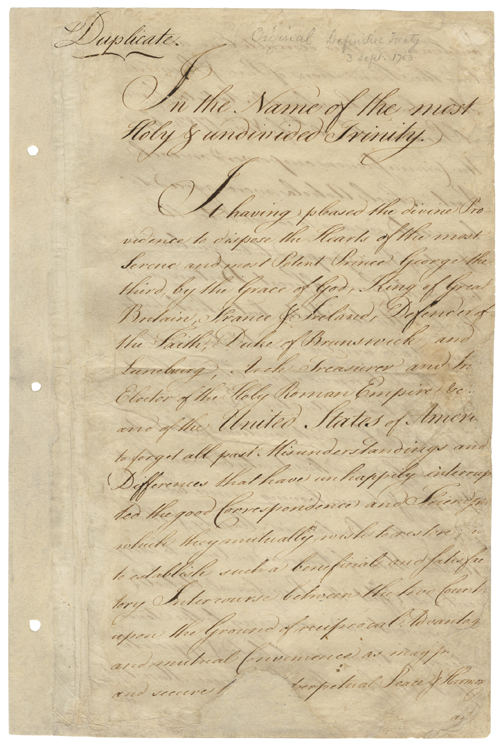
The Hôtel d'York stood on the rue Jacob, on the left bank, a short walk from where Benjamin Franklin had spent much of the war charming the French court. On the morning of 3 September 1783 the American commissioners went there to meet David Hartley, a Yorkshire MP and an old friend of Franklin's, who had been sent by Lord Shelburne's successors to finish what others had started.
The terms were already settled. A preliminary agreement had been signed the previous November, and the intervening months were spent waiting for Britain to close its separate treaties with France and Spain, which were signed the same day at Versailles. What Hartley and the Americans put their names to was, in substance, the deal Franklin, John Adams and John Jay had negotiated the year before.
It was a generous one. Britain recognised the thirteen states as "free, sovereign and independent". The western boundary of the new republic ran along the Mississippi, well beyond the line of settlement, and American fishermen kept their rights on the Grand Banks. Debts were to be honoured on both sides and prisoners released. Article ten allowed six months for ratification.
The document ran to ten articles and about two pages. Hartley signed first, then Adams, Franklin and Jay, in alphabetical order. Jay had wanted the Americans to sign in a form that did not look subordinate; the order was the compromise. Franklin, who was seventy-seven and suffering from gout and a bladder stone, went home afterwards. Hartley went to lunch.
Benjamin West began a group portrait of the peacemakers that autumn. The American side was finished; the British commissioners never sat for it, and the right half of the canvas remains blank to this day.
Congress ratified in January 1784, and the ratifications were exchanged in Paris that May. By then Franklin was already lobbying for a new posting, and the Hôtel d'York had gone back to being a hotel. The building still stands, with a plaque, a few doors from a bookshop.
- Morris, Richard B. The Peacemakers: The Great Powers and American Independence. Harper and Row, 1965.
- Isaacson, Walter. Benjamin Franklin: An American Life. Simon and Schuster, 2003.
- US National Archives, "Treaty of Paris (1783)", Milestone Documents.
- Yale Law School, Avalon Project, text of the Definitive Treaty of Peace, 1783.